10 Halloween Painting Ideas for High School Art Students
If you teach high school art, you already know the problem with most "Halloween painting ideas" floating around Pinterest: they're adorable for a third grader and way too simple for a teenager who has been holding a paintbrush for years. Your students don't need another googly-eyed pumpkin cutout. They need projects that actually stretch their skills while still feeling fun and seasonal.
The best Halloween painting ideas for high school art class push students past the basic pumpkin shape and into real technique: palette knife texture work, value studies from observation, surreal composition, and colour mixing. Below are 10 fall and Halloween painting projects built for teens who are ready for more than a stencil, including a full video tutorial for an abstract pumpkin painted entirely with a palette knife. 🎃
I've taught acrylic painting at both the elementary and high school level, and the gap between what a nine-year-old needs and what a sixteen-year-old needs is huge. These ideas are built for the older end of that gap.
10 Halloween Painting Ideas for High School Art Students
Why High Schoolers Need Different Halloween Painting Ideas
I remember what it felt like to be the kid in high school art class who was more advanced than most of my peers. I loved art, I took it every semester, and I could feel myself getting a little bored with projects that didn't push me. That feeling is exactly what a lot of your strongest students are sitting in right now, and it's worth designing around.
The fix isn't more difficulty for difficulty's sake. It's giving students real artistic decisions to make: how to mix a colour, how to render a texture, how to interpret a subject instead of copying it exactly. A project that only asks a student to follow numbered steps teaches them to follow directions. A project that asks them to observe, choose, and problem-solve teaches them to paint.
That's the thread running through every idea below. Some are quick colour and texture studies you could run in a single period. Others are bigger pieces worth two or three classes. All of them give your students something more interesting to talk about than "I painted a pumpkin."
10 Halloween Painting Ideas for High School Art Students
1. Abstract Pumpkin Painting with a Palette Knife
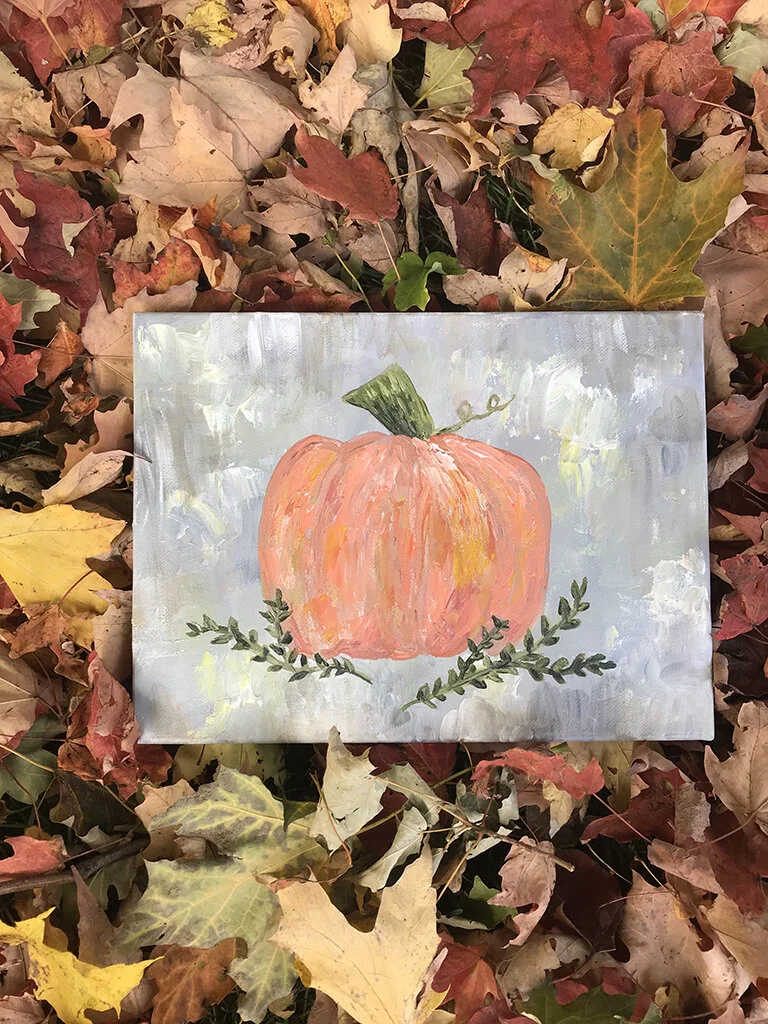
This is the Halloween painting idea I get the most questions about, so I filmed a full tutorial on it: an abstract pumpkin painted entirely with a palette knife, no brush required. Students load thick, undiluted acrylic straight onto the knife and press and drag it onto the canvas in short strokes, building up real ridges and grooves the way a pumpkin's skin actually looks. It's a loose, expressive technique, and it's genuinely one of my favourite tools. I've said before that a spatula is the strangest thing in my own kit that I'd never give up, and this project is exactly why: nothing builds texture like metal dragged through thick paint.
This is also a great moment to remind students of something a painting professor once told me: a painting doesn't need to look exactly like a photo to be good. That's what a photograph is for. An abstract palette knife pumpkin gives students permission to focus on colour, texture, and gesture instead of chasing realism, which takes a lot of pressure off. You can find the full step-by-step video on my YouTube channel, Jackie Partridge Art.
2. Skull Still Life
A skull is a classic Halloween subject that doubles as a serious value study. Set up a plastic or resin skull (or work from a strong reference photo) under a single light source, and have students focus on where the light hits bone, where it falls into shadow, and how form is built almost entirely through value rather than line. It's a more advanced observational challenge than most Halloween projects, which is exactly the point.
3. Halloween Pumpkin Still Life
A more traditional approach to the pumpkin: arrange two or three real pumpkins of different sizes on a table with warm directional lighting, and have students paint from observation rather than from imagination. This is a strong project for practising warm colour mixing (the oranges, the deep shadow tones, the cream highlights) and composition, since no two pumpkins ever sit quite the same way twice. If you want a no-prep warm-up to pair with it, my Halloween symmetry drawing set for grades 9-12 on Teachers Pay Teachers works well as a bell-ringer before students pick up a brush.
4. Texture Study: Bumpy Gourds and Different Pumpkins
This one is purely about surface texture, and it's a great companion to the palette knife project above. Set out a mix of pumpkins and gourds (smooth, warty, ridged, speckled) and challenge students to render each surface convincingly using only three brushes: a 1-inch flat for backgrounds and broad shapes, a number 6 round for blocking in form, and a number 2 round for fine detail. Those are the only three brushes I reach for in about 95 percent of my own paintings, and it's a good lesson for students too: you don't need twenty brushes to get real variety, you need control over a few good ones.
5. Surrealist Haunted House Interior
This is my favourite idea on this list for the students who are getting a little bored. Have them imagine the inside of a haunted house and then push it somewhere impossible: a staircase that melts, a chandelier floating upside down, a hallway that bends in on itself, candles that burn blue. There's no "correct" reference photo to match, which means there's no wrong answer, and that's exactly what a student who's outgrown step-by-step tutorials needs. Painting is about experimenting and breaking rules, and a surrealist piece like this one is a great, low-stakes way to let a confident student prove to themselves that they can invent a whole scene from imagination, not just copy one.
6. Cornfield Painting with a Pink Sunset Sky
A cornfield at dusk, with a soft pink sunset bleeding into orange and gold near the horizon, is a beautiful lesson in gradient blending and atmospheric perspective. Students paint the sky first, wet-into-wet, blending the colours before they dry, then silhouette the cornstalks in the foreground once the sky is set. It's a quieter, more autumnal project if you want to balance out the spookier ideas on this list.
7. Fall Leaves Painting
I'll be honest about this one: the first time I painted a fall leaves tutorial, I was rushing to film it for my email list and the colours turned muddy and brown instead of the rich oranges and reds I wanted. I finished it, sent it out, and then it sat in my studio bothering me until I finally went back, reworked it, and filmed the fix for my YouTube channel. It's a good story to share with students, honestly, because it proves a painting that goes sideways isn't ruined. Acrylic lets you glaze over a muddy colour and rebuild it, layer by layer, until it works. Have students paint a close-up cluster of fall leaves and practise layering warm colour over a value they're not happy with instead of starting over.
8. Red Apple Still Life
Simple, fast, and genuinely useful: a single red apple is one of the best subjects for teaching warm-and-cool colour mixing, since a convincing apple needs reds, a little orange, a touch of green or purple in the shadow, and a bright, almost-white highlight. It's an easy one to slot in as a sub-plan or a quick warm-up at the start of a longer unit.
9. Black Cat Silhouette Against a Harvest Moon
A black cat in silhouette, arched or sitting, against a glowing full moon, teaches two things at once: strong negative space and a soft radial gradient. Students paint the glowing moon and sky first, blending from pale yellow at the centre out to deep blue-black at the edges, then add the cat as a flat, confident silhouette once the sky has dried. It reads as spooky and graphic without needing any detailed rendering, which makes it a good option for students who find value studies frustrating.
Click here for full moon painting tutorial
10. Candy Corn Colour-Block Abstract
This one is really a colour theory lesson wearing a Halloween costume. Students work in hard-edged blocks of candy corn's three warm hues (yellow, orange, and white) using painter's tape or a palette knife to keep the edges crisp, arranging the shapes into a pattern or abstract composition of their own design. It's quick, it's playful, and it's a nice palate cleanser after some of the heavier observational projects above.
FAQ: Halloween Painting Ideas for High School
What are good Halloween painting ideas for high school students? Look for projects built around real technique rather than simple crafts: palette knife texture work, observational still life (a skull or pumpkins), surreal imaginative scenes, and colour studies like a candy corn abstract or a sunset cornfield. These give teens skills to build on, not just a seasonal shape to colour in.
What painting technique works well for a Halloween pumpkin project? A palette knife is one of the best tools for a pumpkin painting. Loading thick acrylic straight onto the knife and dragging it onto the canvas builds the natural ridges and texture of a pumpkin's skin without needing to paint every line by hand.
How do I make Halloween art lessons feel less babyish for teenagers? Shift the focus from the subject to the skill. A pumpkin still life painted from real observation, with attention to light, shadow, and colour mixing, is a completely different lesson than a pumpkin cutout, even though the subject matter looks similar on the surface.
What supplies do I need for a palette knife pumpkin painting? Heavy body acrylic paint (it holds texture better than fluid acrylic), a palette knife or two in different sizes, and a canvas or canvas board. You don't need to water the paint down for this technique at all.
Can beginner painters handle a surrealist haunted house project? Yes. Surrealism takes the pressure off technical realism, since there's no single correct way for an imaginative scene to look. It's actually a forgiving project for a less confident painter, and a great stretch for a more advanced one.
Related Articles:
Fall/Halloween Symmetry for Grades 9-12
Halloween Craft Ideas for Adults
Halloween Art Projects for Elementary